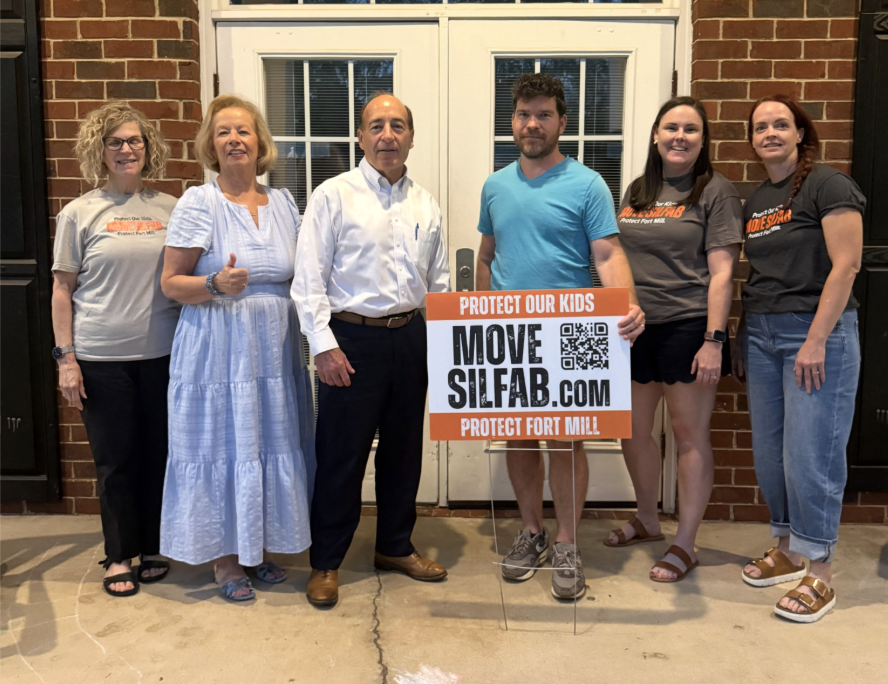
Move Silfab protesters gathered outside the York County Government Center on Oct. 19, chanting "Follow the order," "Enough is enough" and "We won't back down" ahead of a York County Council meeting, the Post and Courier reported.
The group opposes Silfab Solar's plans to resume chemical-based manufacturing at its plant on Logistics Lane in Fort Mill. The Canadian company makes solar panels next to two Fort Mill School District campuses: Flint Hill Elementary, which opened in 2025, and Flint Hill Middle, which opened in August.
"The fight has gone on for about three-and-a-half years," Fort Mill resident Brendan McCluskey told the Post and Courier. "So we've been, in spirit, outside for three-and-a-half years."
Public protests date back to 2022, when Silfab began construction. Residents have raised concerns about traffic, chemicals and the proximity of an industrial site to schools and thousands of homes. The controversy intensified in March, when roughly 300 gallons of water mixed with potassium hydroxide leaked from the plant's scrubber system. Two days later, the company confirmed a delivery had been dripping hydrofluoric acid. The Fort Mill School District closed Flint Hill Elementary for two days.
The South Carolina Department of Environmental Services (DES) ordered Silfab to halt operations and submit to an independent engineering review. Silfab has since limited its work to assembly.
Residents pack council meetings
Protesters also packed York County Council meetings after the March spills, demanding the council revoke Silfab's certificate of occupancy, according to the Post and Courier. At the Oct. 19 meeting, residents pressed county leaders for concrete action.
“Silfab filed a legal complaint against York County to end the zoning dispute,” a Silfab Solar spokesperson told the Post and Courier. “This is not a hostile move but rather a standard legal procedure known as seeking a declaratory judgment, with the goal of securing a final and binding court confirmation that Silfab’s operations fully comply with the laws and permits granted.”
McCluskey said he believes York County should take accountability for the permitting process. He alleged the county issued permits and a certificate of occupancy for a light industrial zone when the operation should have been classified as heavy industrial, the Post and Courier reported.
Silfab's position is that no mistakes were made by the county.
Chemical restart in limbo
Oct. 19 was the earliest date Silfab had planned to resume chemical commissioning. But the S.C. Department of Environmental Services told WCNC Charlotte its Bureau of Air Quality had not received the required 72-hour advance notification from Silfab as of 5 p.m. Oct. 19. As of Oct. 20, Silfab had not resumed manufacturing at the Fort Mill site, the Post and Courier reported.
Lawsuits multiply
On Oct. 16, Silfab and York County filed competing lawsuits 19 minutes apart, both asking a judge for a declaratory judgment on whether a 2024 zoning board ruling against solar manufacturing in light industrial zones applies to Silfab's already-approved operations, WRHI reported. Neither side seeks damages.
Silfab argues the zoning interpretation applies only to future projects. The county wants the court to clarify whether the earlier order requires enforcement action against a use it already approved.
A separate case brought by the nonprofit Citizens Alliance for Government Integrity (CAGI) against Silfab, property owner Exeter 7149 and York County is scheduled for a hearing Nov. 12. The U.S. Supreme Court denied a CAGI petition for review Oct. 5, according to the county's filing.
Silfab President and CEO Paolo Maccario has maintained the company holds all permits needed to operate. The company says it employs more than 700 of its 1,200 workers in Fort Mill. After the March incidents, Silfab completed the state-required engineering review, posted the report publicly and named Jamie Watts as corporate director of health and safety.
No hearing date has been set on the Oct. 16 lawsuits. Silfab's appeal of the zoning board ruling remains pending before the S.C. Court of Appeals.